MiniArp
Version 1.1.1
MiniArp is a compact gate-driven arpeggiator inspired by the 2hp Arp. It plays the notes of one of 19 tone sets (14 chords, 3 pentatonic scales, 2 intervals) in a chosen playback mode across up to 4 octaves. Every incoming clock pulse advances the arpeggio one step. The root note and the tone set can both be modulated from CV.
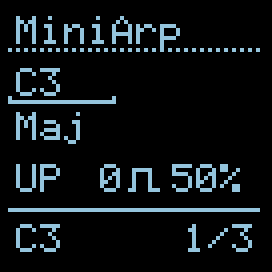
I/O
| 1/3 | 2/4 | |
|---|---|---|
| TRIG | Clock — advance to the next step | Reset to the first step |
| CV INs | Root offset (1V/oct, quantised) | Chord selector offset (0..+5V sweeps) |
| OUTs | Pitch (V/oct) | Gate pulse (length = Gate %) |
UI Parameters
- Root — the root MIDI note of the arpeggio (C-1 .. G9). Quantised CV at input 1 is added in semitones.
- Chord — one of 19 tone sets (see table below). CV at input 2 sweeps proportionally across the list.
- Mode — playback mode (7 options — UP / DN / PN / PP / PD / BR / RN).
- Oct — octave range shift, Keystep-style:
-1,0,+1,+2,+3. See below. - Gt.len — gate pulse length, 1..99 % of the current clock period (minimum 10 ms floor).
Cursor order on the screen: Root → Chord → Mode → Oct → Gt.len.
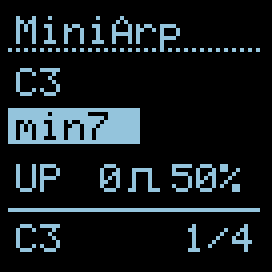
The cursor uses the standard Hemisphere two-state visual: a blinking underline beneath the value in NAV (just selecting), an inverted box around the value in EDIT (encoder changes it). While editing Root or Chord, the value momentarily shows the base knob value (not the CV-modulated effective value) so the encoder feedback is unambiguous.
Tone Sets (19)
First 14 follow the 2hp Arp manual order. Then 3 pentatonic scales. Then 2 intervals.
| Label | Intervals (semitones) | Common name |
|---|---|---|
| Maj | 0, 4, 7 | Major |
| Maj7 | 0, 4, 7, 11 | Major 7 |
| Dom7 | 0, 4, 7, 10 | Dominant 7 |
| min | 0, 3, 7 | Minor |
| min7 | 0, 3, 7, 10 | Minor 7 |
| dim | 0, 3, 6 | Diminished |
| hdim7 | 0, 3, 6, 10 | Half-diminished 7 (m7♭5) |
| dim7 | 0, 3, 6, 9 | Fully diminished 7 |
| aug | 0, 4, 8 | Augmented |
| aug7 | 0, 4, 8, 10 | Augmented 7 |
| sus2 | 0, 2, 7 | Sus 2 |
| sus4 | 0, 5, 7 | Sus 4 |
| s4M7 | 0, 5, 7, 11 | Sus 4 / Major 7 |
| s4m7 | 0, 5, 7, 10 | Sus 4 / Minor 7 (7sus4) |
| majP | 0, 2, 4, 7, 9 | Major pentatonic |
| minP | 0, 3, 5, 7, 10 | Minor pentatonic |
| bluM | 0, 3, 5, 6, 10 | Minor blues (+♭5) |
| 5th | 0, 7 | Power chord |
| Oct | 0, 12 | Octave doubler |
Note on Oct and octave range. Oct = {0, 12} combined with a non-zero octave shift produces intentional duplicate notes: C, C', C', C'', C'', C''' for +3. This is by design — useful as a rhythmic pulse with octave steps. If you want non-duplicating octave climb, use 5th, Maj, or any other set with more than one distinct tone.
Playback Modes (7)
| Label | Description |
|---|---|
| UP | Ascending — 0, 1, 2, …, M-1 repeat |
| DN | Descending — M-1, M-2, …, 0 repeat |
| PN | Pendulum — endpoints play once: 0,1,2,…,M-1,M-2,…,1 |
| PP | Ping Pong — endpoints play twice: 0,1,…,M-1,M-1,M-2,…,0 |
| PD | Pedal Point — root against ascending others: 0,1,0,2,0,3,…,0,M-1 |
| BR | Brownian — drunken walk: 50% forward, 25% stay, 25% back |
| RN | Random — uniform over [0, M) on every step |
Terminology follows Intellijel Metropolix v1.4. M = tones_in_set × octave_range.
- PD (Pedal Point) gives the classic organ-pedal sound — a fixed root note alternating with every other note in the set. On
Maj× 3 octaves this becomes a dramatic C against ascending E G C’ E’ G’ C’’ etc. - BR (Brownian) is a gentler alternative to pure Random — probabilities 50/25/25 produce a walk that drifts forward with occasional repeats and reversals. Feels organic, not noisy.
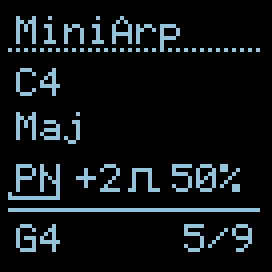
Mid-playback display — PN mode, +2 octaves expand the 3-note Maj set to M=9 slots, the bottom row’s step / total field shows the current position (5/9 here):
Octave Range (Oct)
Keystep-style: -1, 0, +1, +2, +3.
| Value | Effect | Resulting range | | —– | ————————————————— | ———————- | | -1 | Expand down one octave | octaves -1, 0 | | ` 0 | Play only the source octave | octave 0 | | +1 | Expand **up** one octave | octaves 0, +1 | | +2 | Expand up two octaves | octaves 0, +1, +2 | | +3` | Expand up three octaves | octaves 0, +1, +2, +3 |
Asymmetry is intentional: higher registers are more useful in arpeggiators, while -1 covers the “doubled bass” case.
Modulation
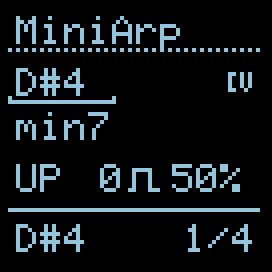
- The CV icon appears next to Root or Chord while the corresponding CV input is actively shifting the value.
- Root CV uses 1V/oct semitones (e.g. +1V = +12 semitones). The knob value sets the base MIDI note; CV is added on top.
- Chord CV is proportional: +5V adds +19, −5V subtracts 19. The result is clamped to the valid range. A small dead-zone (≈ 62 mV around 0V) prevents idle noise from drifting the selection.
Gate
- The bottom row of the screen shows the current playing note (e.g.
C3) andstep / totalposition. - A small gate icon next to the Gate % value lights up while the physical gate output is high — useful for visual timing feedback.
- If the requested gate duration is shorter than 10 ms (very fast clock + short %), the pulse is stretched to 10 ms minimum so downstream envelopes and drum modules reliably trigger.
Clip Indicator
An arrow next to the playing note lights up when the computed MIDI note exits the 0..127 range and has to be clamped:
↑— clipped up (beyond G9). Typical cause: high Root ++3octave range.↓— clipped down (below C-1). Typical cause: low Root +-1octave, or a large negative Root CV.
| Up clip | Down clip |
|---|---|
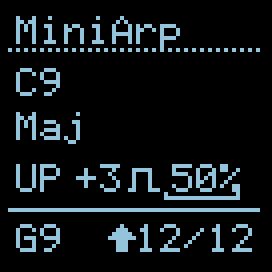 | 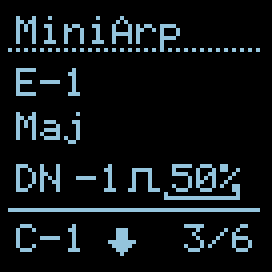 |
Lower (or raise) the Root, or choose a smaller octave range.
Persistence
State is packed into 64 bits: root (7), chord (5), mode (3), oct_shift (3, stored as unsigned offset), gate_pct (7). Presets from v1.0.0 are not compatible — re-save after update.
Credits
Inspired by the 2hp Arp, extended with ideas from Intellijel Metropolix (Pedal Point, Brownian, Pendulum / Ping Pong terminology) and Arturia KeyStep Pro (octave range parameter). Adapted to Hemisphere by Victor Kuznetsov for O_C-Phazerville.